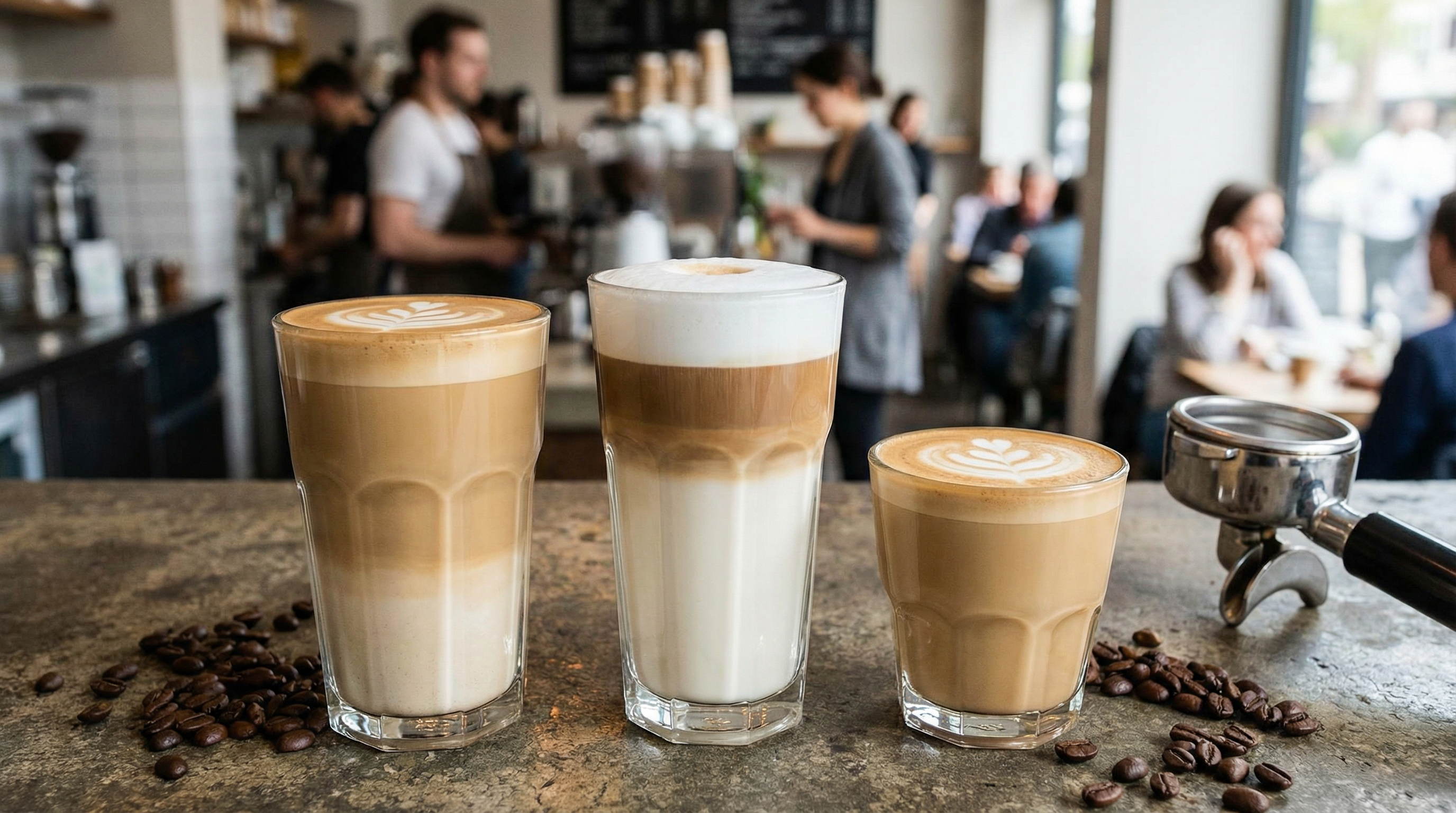
Latte, latte macchiato, and flat white all combine espresso and milk, but the ratios, order of assembly, and texture of the milk differ. That’s why they taste and feel different in the cup. This guide breaks down what each drink is, how they’re made, and how to tell them apart—whether you’re ordering at a café or making them at home with your best espresso machine.
What Is a Latte?
A latte (short for caffè latte, “milk coffee”) is espresso with steamed milk and a thin layer of foam on top. The usual ratio is one or two shots of espresso (1–2 oz) to a larger amount of steamed milk (often 5–8 oz or more), so the drink is milk-forward and mild. It’s typically served in a larger cup (8–12 oz) and has a smooth, creamy texture with just enough foam to hold a design or a dusting of cocoa. The espresso is the base; milk is poured over it. If you want a gentle, milky drink that still tastes like coffee, a latte is the classic choice. For equipment at home, see our best espresso machine guide; your machine’s steam wand is the main tool for steaming milk.
What Is a Latte Macchiato?
“Macchiato” means “stained” or “marked.” In a latte macchiato, milk is the base and espresso is added on top—so the espresso “stains” the milk. You get distinct layers: steamed milk on the bottom, a shot of espresso in the middle, and foam on top. It’s often served in a tall glass so you can see the layers. Because the espresso sits on top and you might sip it first or mix as you drink, the experience can feel different from a latte—sometimes a bit stronger at the start. The ratio of milk to espresso can be similar to a latte, but the build is reversed. If you like the visual and the layered taste, order a latte macchiato; if you prefer everything blended and milk-forward, stick with a latte.
What Is a Flat White?
A flat white is espresso with steamed milk and microfoam—velvety, small-bubble foam that’s integrated into the milk rather than sitting on top as a thick layer. It’s usually stronger than a latte because the ratio has less milk: often a double shot (2 oz) to 4–5 oz of milk, so the espresso is more present. It’s served in a smaller cup (5–6 oz) and has a smooth, silky texture with no big bubbles. The “flat” in the name refers to the flat (smooth) surface, not flat flavor. Flat whites became famous in Australia and New Zealand and are now standard in specialty cafés. If you want espresso and milk in balance with a smooth texture and no heavy foam, a flat white is the pick. Making one at home requires a good espresso machine with a capable steam wand for microfoam.
Side-by-Side Comparison
| Latte | Latte Macchiato | Flat White | |
|---|---|---|---|
| Base | Espresso, then milk | Milk, then espresso on top | Espresso + microfoam milk |
| Ratio | More milk, 1–2 shots | Similar milk to espresso | Less milk, usually double shot |
| Foam | Thin layer on top | Layer on top | Microfoam throughout, “flat” top |
| Cup | Larger (8–12 oz) | Tall glass | Smaller (5–6 oz) |
| Strength | Mild, milk-forward | Depends how you sip | Stronger, espresso-forward |
How to Make Them at Home
For all three you need espresso (one or two shots) and steamed milk. For a latte: pull the shot(s), steam the milk with a thin layer of foam, pour the milk over the espresso. For a latte macchiato: steam the milk first and pour it into a tall glass, then pull the shot(s) and pour the espresso over the milk so it layers. For a flat white: pull a double shot, steam the milk to microfoam (no big bubbles), and pour so the milk and foam are integrated—smaller total volume than a latte. A good burr grinder and espresso machine are the foundation; practice your steaming for consistent texture.
Conclusion
Choose a latte for a mild, milky drink; a latte macchiato for layered presentation and a reversed build; and a flat white when you want espresso and smooth texture in balance with less milk. All three are espresso-based; the difference is in the build and the ratio.
See Also
- Best Espresso Machine — for pulling shots and steaming milk at home.
- Best Burr Grinders — for consistent espresso grind.
- Best Coffee Makers — compare espresso with drip and single-serve.